
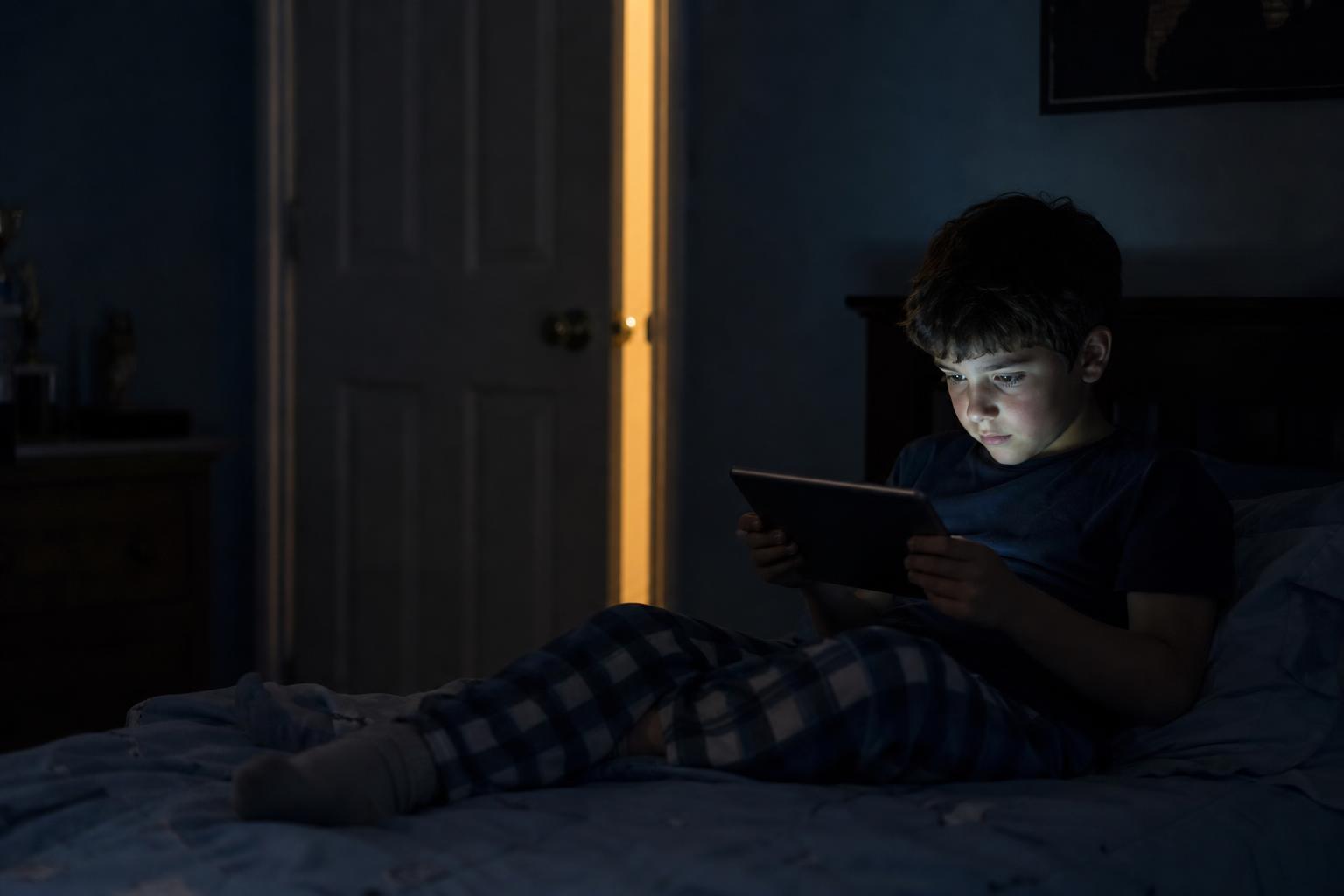
What screens do at each age
The risks aren't the same at three, nine and fifteen — and neither is the fix. Here's what the research says lands hardest in each band, and the words to use when you sit down for the chat.
Little brains, big impact
This is the window where language is being built word by word — and every minute of passive screen time is a minute not spent in back-and-forth conversation with you. The American Academy of Pediatrics recommends no more than about an hour a day of high-quality co-viewed content for 2–5s, and warns that even background TV in the room reduces the parent-child talk that fuels vocabulary. The World Health Organization goes further: under 2, none at all.
The trap I fell into with my first: handing over the phone to end a tantrum. It works in the moment, and it teaches the brain that big feelings are solved by a screen. If nothing else at this age, protect sleep — no devices in the bedroom, and no screens in the hour before bed.
First ads, first purchases, first accidental porn
Attention and reading stamina are still forming, and this is the age when kids meet the two things schools rarely warn you about: manipulative advertising, and in-game purchases dressed up as gameplay. Common Sense Media finds three in four 8–11s can't reliably tell an ad from actual content.
Harder to talk about, and more important: the Common Sense Media research puts the average age of first exposure to online pornography at around 12 — but 15% of kids saw it at age 10 or younger, and more than half (54%) had seen it by age 13. Most stumble on it accidentally: a pop-up, an autoplayed video, someone else's phone. Say it plainly, once, before it happens: "If anything on a screen makes you feel weird in your tummy, close it and come tell me. You will not be in trouble."
Independent messaging + a comparison machine
Two things collide in this band. First, most kids get their own device and their first independent messaging — Snapchat, Discord, WhatsApp, group chats they run without you in the room. That's when the eSafety Commissioner's data on kids communicating with people they first met online stops being theoretical: 55% of Australian children aged 8–17 had done so, and many of their parents had no idea.
Second, the comparison machine switches on. The US Surgeon General's youth-mental-health advisory found teens spending more than three hours a day on social media roughly doubled their risk of anxiety and depression symptoms, with the effect strongest for girls in early adolescence. Sleep loss from a phone in the bedroom compounds all of it. Device-free bedrooms overnight is still the single biggest free win at this age.
Sextortion, body image, and the AU under-16 ban
Financial sextortion is the risk that has grown fastest for teenagers in the last three years, and it targets boys aged roughly 14–17 hardest — the ACCCE and FBI both flag this age band specifically. The script is almost identical every time: a fake peer account, a flirty exchange, a request for an image, then a demand for money. Kids don't tell because they're ashamed. Say the sentence before it happens: "If anyone ever threatens you with a photo, come to me. We don't pay, we don't send more, we sort it together."
The other slow burn at this age is the drift of algorithmic feeds toward body-image, disordered-eating, and self-harm content, especially for girls — well-documented by the US Surgeon General's advisory. And a policy piece worth knowing: Australia's under-16 social media ban took effect on 10 December 2025, but 96% of 10–15s were already using social media before it landed, per eSafety. The law helps at the edges; the conversation in your kitchen is still doing the heavy lifting.
It turns up whether they look or not
Pop-ups, autoplay recommendations, mistyped searches — kids don't have to go looking for trouble online to find it. More than half of teens say they stumble onto explicit content by accident. The doesn't care how old you are.
That statistic stopped me cold when I read it. My eight-year-old is a good kid who loves dinosaurs and Minecraft. He doesn't search for adult content. But a single wrong tap on a suggested video can take him somewhere I never intended.
Source: Common Sense MediaSocial media starts earlier than the rules say
Minimum-age laws are catching up — Australia's under-16 social media ban took effect on 10 December 2025, and the US, UK and others are bringing in their own age checks and parental-consent rules. That's a good thing. But here's the catch: 96% of Australian kids aged 10 to 15 had already used social media before the ban landed. The horse has bolted for many families, wherever you live.
The US Surgeon General has warned that more than three hours a day on social media roughly doubles the risk of anxiety and depression symptoms in teenagers. For primary-schoolers, the effects are even more pronounced. The platforms are designed to be addictive — and they work.
Games are where the strangers are
For a lot of kids, the first chat with a stranger happens inside a game, not on social media. Over half of Australian children say they've contacted someone they first met online — and only a third of their parents knew about it.
Roblox is the big one in our house. Around 40% of its players are under 13, and it's faced documented safety problems and lawsuits from multiple US states. I haven't banned it — I've set it up properly. That means private accounts, chat restrictions, and keeping an eye on what servers they're joining.
AI is the new one to watch
About 64% of teenagers now use an AI chatbot of some kind. Most of that is harmless homework help. But some 'companion' apps are designed to encourage sexual chats, and 'nudifier' tools can create fake explicit images from innocent photos.
The Internet Watch Foundation reported a huge rise in AI-generated child abuse material in 2025. This is moving fast — faster than the law can keep up with. The best protection right now is knowing it's out there, talking about it, and keeping devices in shared spaces.
Source: eSafety CommissionerScreens, sleep and little brains
The American Academy of Pediatrics recommends about one hour a day of high-quality content for children aged 2 to 5. For school-age kids, the key is consistent limits that protect sleep, physical activity, and face-to-face play.
Device-free bedrooms are the single easiest free win. No tablets, phones, or handheld consoles in bedrooms overnight. It removes temptation, protects sleep, and gives kids a genuine break from the online world. We started this two years ago and I wish we'd done it sooner.
Source: American Academy of PediatricsAds are aimed straight at them
Three in four kids aged 8 to 11 can't reliably tell an advertisement from actual content. Free apps and games make their money by tracking behavior and marketing to children — often without clear consent.
This isn't about one bad app. It's a systemic issue. When your child plays a "free" game, they're usually the product being sold to advertisers. Content filtering and ad-blocking tools are a straightforward way to cut most of this out.
Source: Common Sense MediaCyberbullying follows them home
53% of Australian children have experienced cyberbullying. Reports to the eSafety Commissioner have risen over 450% in the past five years. Unlike the schoolyard bullying I remember, this doesn't stop at the front gate.
If your child is dealing with serious or repeated cyberbullying, you can report it directly to the eSafety Commissioner. For anything involving threats, image-based abuse, or grooming, contact the police as well. Don't wait to see if it blows over.
Source: eSafety CommissionerHow grooming and sextortion actually work
Predators don't jump straight to the scary stuff — that's why kids miss it, and why we do too. The pattern is boringly consistent: contact in a public space (a game lobby, a comment section, a after a livestream), build trust with flattery and shared interests, isolate onto a private app like Snapchat or Discord, escalate to a request for an image or a video call, then threaten — pay up or I send this to your school, your nan, your team.
Financial of teenage boys is the fastest-growing version of this in Australia right now, and the FBI has issued the same warning in the US. Most kids don't tell a parent because they feel stupid, ashamed, or scared they'll lose the device. The single most useful sentence you can say tonight is: "If anything online ever goes sideways, you are not in trouble with me. We fix it together."
If it's already happened: don't pay, don't send more, screenshot, block, and report to the eSafety Commissioner and the Australian Centre to Counter Child Exploitation (ACCCE). Both can move fast on takedowns.
Gaming spend is engineered, not accidental
, battle passes, gem packs, skins — none of these are random. They're behavioral products designed by teams of psychologists to feel unfair to resist. Rewards drip in on variable schedules (the same mechanism as poker machines), progress bars sit maddeningly close to full, and limited-time offers manufacture urgency on a school-night timeline. Kids don't stand a chance without a hand on the wheel.
The World Health Organization formally recognised "gaming disorder" in the ICD-11, and Australian and international researchers have consistently linked loot-box spending in kids to problem-gambling symptoms later. The fix isn't a lecture — it's a hard limit at the payment layer: no card on file, ask-to-buy on, a monthly spend of zero as the default.
Algorithmic rabbit holes
Recommender feeds — TikTok's For You, YouTube's Up Next, Instagram's Reels — are tuned for one thing: keep you watching. The unintended side effect is that they drift, quickly, toward whatever provokes the strongest reaction. For a teenage girl that can mean disordered-eating and self-harm content within an afternoon of watching a couple of workout videos. For a teenage boy it can mean misogyny or extremist content off the back of a few gym or gaming clips.
This isn't a hunch — the US Surgeon General's youth advisory and multiple eSafety Commissioner submissions have called it out directly. Practical mom-level fixes: turn off personalized recommendations where the platform allows it, watch the feed with your teen once a week (silently, no commentary — you'll see what they see), and teach them the "not for me" / "not interested" button until the algorithm gets the hint.
So what do I actually do?
You don't need to do everything on this page. Start small: switch on the free built-in controls already sitting on your phone (remember they're platform-specific — Apple only manages Apple, Google only manages Android), and turn on ad and content filtering. If you've got a curious pre-teen who'll quietly switch the free stuff back off, that's when a paid all-rounder app earns its keep. Most families are 80% protected with about 20 minutes of setup.
Keep reading
Warning Signs Something's Wrong Online
What to notice in mood, sleep, secrecy and screen use — without panicking.
Read articleTalk to Your Kids About Online Safety
Age-by-age openers and calm scripts for the moments that matter.
Read articleParental Controls Explained
The device, app and network controls that do the most useful work.
Read articleHow to Block Inappropriate Websites
A layered setup using device controls, filters and family DNS.
Read articleApp & Game Safety Scoreboard
Honest verdicts on the apps and games parents ask about most.
Read articleIf something has already happened
Worry is completely normal — every parent feels it. If your child is dealing with something serious like grooming, image-based abuse, or repeated threats, you are not alone and it is not your fault. Use the directory below, and contact your local police if you're worried about immediate safety. They have specialist teams who handle this every day.
United States
- 911 — Emergency
- 988 Suicide & Crisis Lifeline — Call or text 988 · 988lifeline.org
- NCMEC CyberTipline — 1-800-843-5678 · 24/7 · report.cybertip.org
- Take It Down (NCMEC) — Free image removal · takeitdown.ncmec.org
United Kingdom
- 999 — Emergency
- Childline — 0800 1111 · free, 24/7 · childline.org.uk
- CEOP Safety Centre — National Crime Agency · ceop.police.uk/Safety-Centre
- Report Remove — Childline + IWF · childline.org.uk
- NSPCC helpline — 0808 800 5000 · Mon–Fri 10am–4pm · nspcc.org.uk
- Samaritans — 116 123 · free, 24/7 · samaritans.org
Australia
- 000 — Emergency
- Kids Helpline — 1800 55 1800 · free, 24/7 · ages 5–25 · kidshelpline.com.au
- Lifeline — 13 11 14 · free, 24/7 · lifeline.org.au
- eSafety Commissioner — Legal takedown powers · esafety.gov.au/report
- ACCCE (AFP-led) — 24/7 reporting · accce.gov.au/sextortionhelp
- ThinkUKnow Australia — AFP-led · thinkuknow.org.au